


How the AI buildout is being paid for, and why it matters to anyone signing a vendor contract this year.
I believe a vendor commitment is only as good as your read on the vendor’s own commitments.
That is hard right now, because the AI buildout is being financed with instruments most of us have never had reason to open. They are not hidden. They are in filings, press releases, and interview transcripts, written in a language operators were never asked to learn.
So I spent the last few weeks reading them. Here is the pattern, and it holds across nearly every structure I found:
The debt moved. The risk only changed hands.
Some of it stayed with the companies that moved it. Some of it landed on people who never signed anything. The rest of this article shows where.
Two numbers that are both true
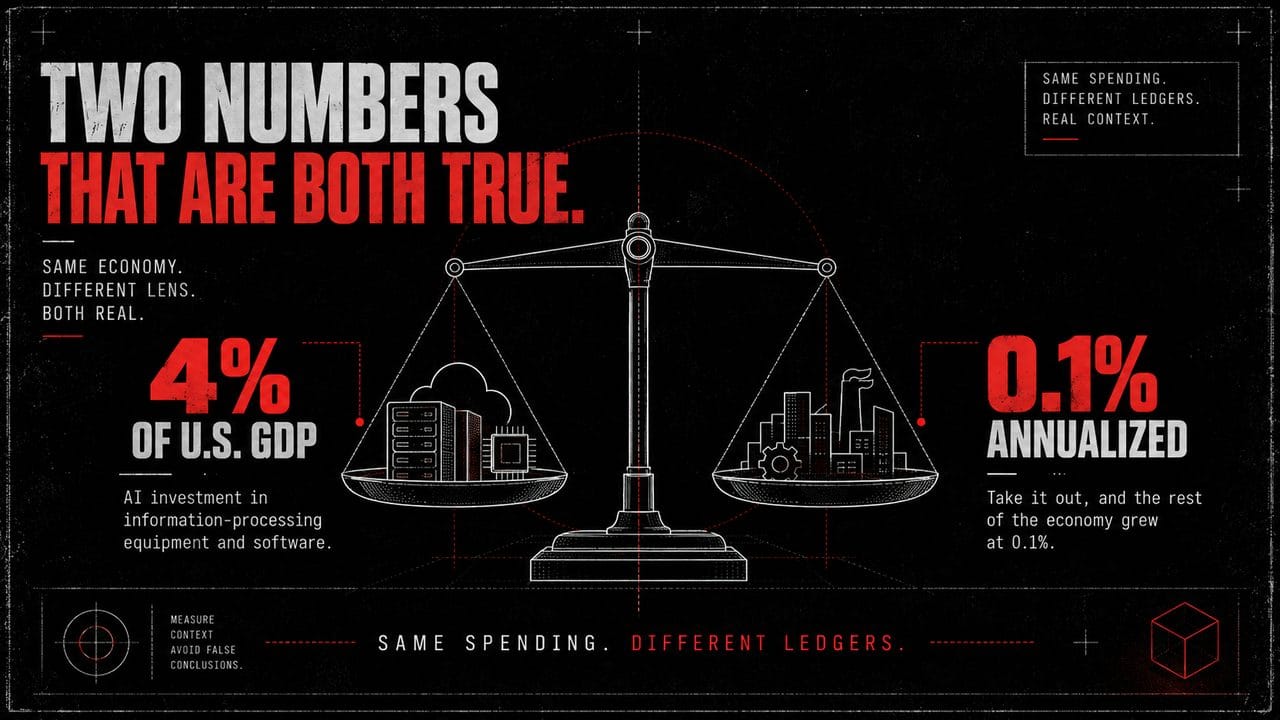
Jason Furman, who chaired the Council of Economic Advisers under President Obama, pointed out last fall that investment in information-processing equipment and software is about 4% of US GDP, and that it accounted for 92% of GDP growth in the first half of 2025. Take that category out of the arithmetic and the rest grew at a 0.1% annualized rate. [1]
Goldman Sachs chief economist Jan Hatzius looked at the same year and said AI investment added “basically zero” to measured US growth, because most of the equipment is imported, and an import subtracts on the trade line what it adds on the investment line. In his words, the spending “adds to Taiwanese GDP, and it adds to Korean GDP but not really that much to U.S. GDP.” [2] Federal Reserve economists made the same point in July, noting the “high import-content of the equipment underlying the buildout.” [3]
Both can be true. The spending is real, and where it lands depends on which line of the ledger you read. That is the same question this whole article is about.
The import point comes back. The equipment on Taiwan’s export line is the same equipment that shows up further down this article as collateral on American loans. The manufacturing dollars land abroad. The debt stays here.
That is not the same as saying a supply shock would sink those loans. If the chips stopped arriving, scarcity would probably push the resale price of the chips already here up, not down, and the collateral would look better on paper. What breaks is the plan the loan was sized for. A GPU-backed loan is repaid from what the GPU earns, and a borrower that cannot expand cannot grow into its debt. That distinction matters more than the resale price, and it runs through everything below.
What the spending is
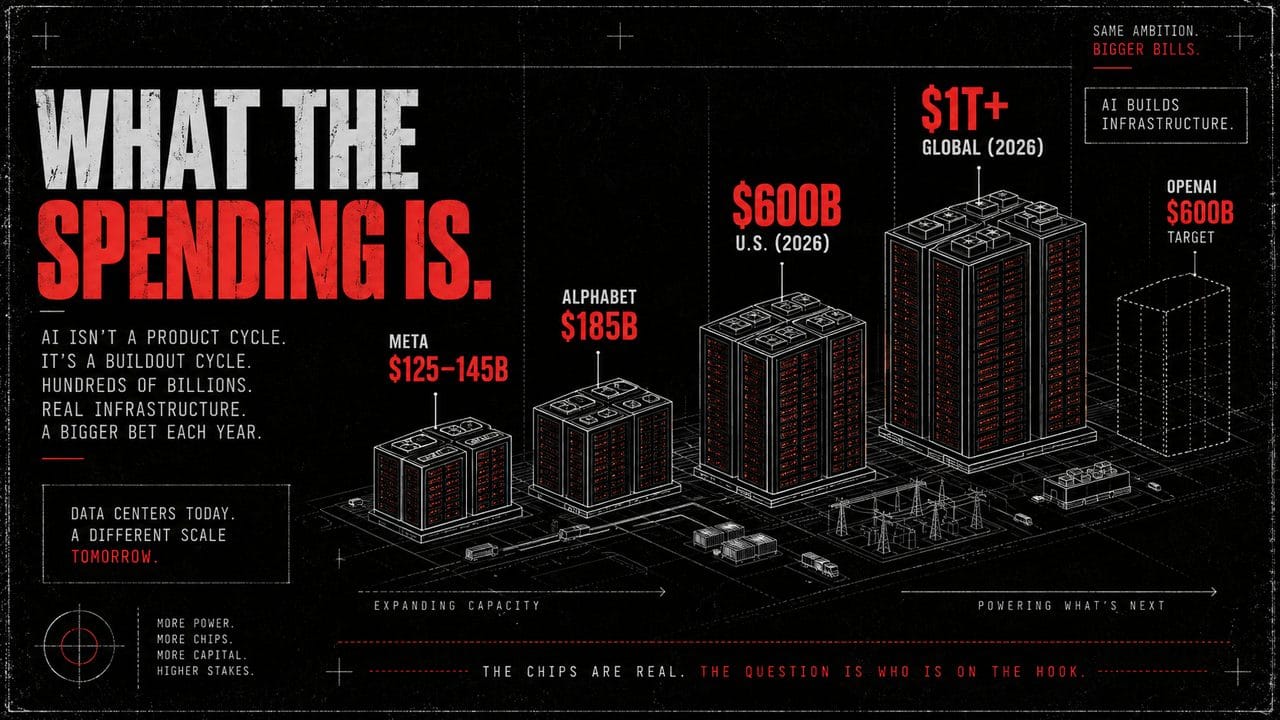
Goldman puts 2026 AI investment at roughly $600 billion in the US and over $1 trillion globally. [4] Meta guided 2026 capital spending to between $125 and $145 billion. [5] Alphabet has said it plans about $185 billion. [6] By Vanguard’s count, five large hyperscalers issued about $35 billion a year in US bonds from 2020 through 2024, $93 billion in 2025, and roughly $132 billion in the first seven months of this year. [7]
Sam Altman said last November that OpenAI had about $1.4 trillion in compute commitments; in February the company told investors its spending target through 2030 is closer to $600 billion. [8] In the first quarter of this year it burned $3.7 billion in cash on $5.7 billion of revenue, according to documents The Information reviewed. [9] Anthropic’s annualized run rate reached $65 billion at the end of July, up from $9 billion at the end of last year, per TechCrunch. That is a run rate, not audited revenue. [10]
The chips are real and the orders are real. The question is who is on the hook for them.
The instruments, in plain English
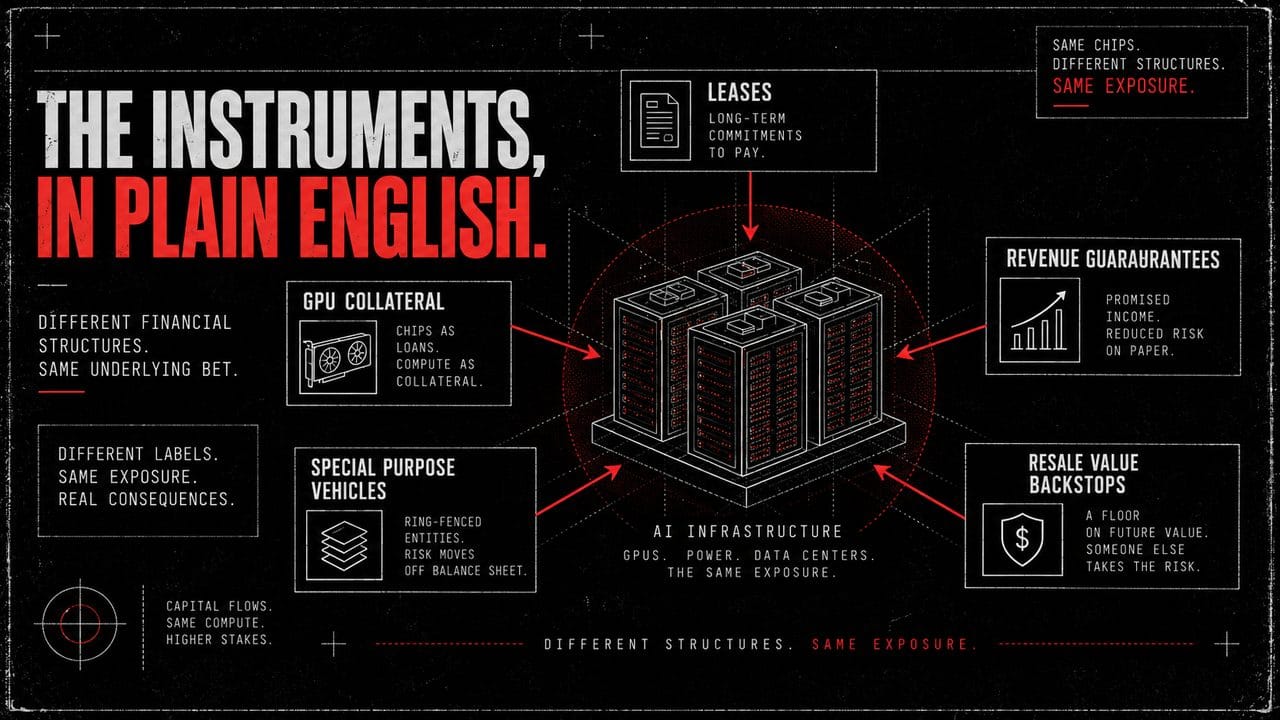
Rent instead of capex
Meta’s Hyperion data center is 80% owned by funds managed by Blue Owl. Meta holds 20% and leases it back, on an initial four-year term with renewal options. The joint venture raised about $27 billion, most of it bonds. [11] Meta will carry the lease on its own books, as accounting rules require, and its own release discloses a residual-value guarantee that runs for the first 16 years. So the risk did not leave Meta. The debt did, along with the cash that would have been spent up front.
The chips are the collateral
CoreWeave closed an $8.5 billion loan facility in March secured by its GPUs and a customer contract. The facility was rated A3 by Moody’s and A (low) by DBRS; CoreWeave says it is the first GPU-backed financing to get an investment-grade rating. [12] In May a separate $3.1 billion facility was publicly syndicated, so it can trade like a bond. [13] The lenders are underwriting the contract and the hardware behind it.
The seller guarantees the buyer’s revenue
In September 2025, Nvidia agreed to buy CoreWeave capacity that goes unsold to other customers, subject to conditions, through April 2032, for up to $6.3 billion. [14] The SEC filing describes it as an obligation. That guarantee strengthens the revenue stream sitting behind the financing.
The seller funds the buyer’s vehicle
Last October, xAI was raising about $20 billion through a special purpose vehicle, roughly $7.5 billion of equity and $12.5 billion of debt, that buys Nvidia GPUs and leases them to xAI over five years. Nvidia was reported to be putting up to $2 billion into the equity. [15] The chipmaker helps fund the entity that buys its chips, and the lenders’ collateral is the chips.
The seller backstops the resale price of its own product
This is the one I keep coming back to. On August 10, Nvidia signed memorandums of understanding with Apollo, BlackRock, Blackstone, Brookfield, Goldman Sachs and KKR to mobilize over $500 billion of outside capital for AI infrastructure, with GPUs as collateral. [16] Alongside it, TechCrunch reported, Nvidia has also said it could cover up to roughly 25% of certain residual-value shortfalls if the chips lose more value than expected. [17]
On CNBC that day, Jensen Huang said: “This is really the first time that technology chips have become an investable asset class.” He described them as “productive, they’re long-lived, they’re fungible, they’re flexible.” [18]
A chip can keep working for years and still be hard to resell, so those are not contradictory. But notice what the lenders asked for. They did not take “long-lived” on its own. They took it with a manufacturer backstop attached.
And the rest, briefly
There is more. Alphabet sold a 100-year bond in February, the first from a tech company since 1997. [6] Oracle has financed its buildout mostly with debt and carries negative outlooks from both S&P and Moody’s. [19] Nvidia’s “up to $100 billion” for OpenAI turned out to be a letter of intent that Huang later called “never a commitment.” [20] Microsoft books its share of OpenAI’s losses, $3.1 billion in one recent quarter, in a line called “Other, net.” [21] And when SpaceX bought Cursor with $60 billion of newly public stock, OpenAI invoked the change of control and gave Cursor a date to lose direct model access. [22] That last one is its own article.
The objection, and why it only half works
The strongest objection is a fair one. None of these instruments is new. Sale-leasebacks, equipment-backed loans, and take-or-pay contracts are standard finance. Vendor financing is old too. Railroads did it. Lucent and Nortel did it in 1999. Noah Smith has argued that circular does not mean fraudulent, and that building this is expensive enough that somebody has to carry the paper. [23] I think that is right. And the hyperscalers are funding this out of some of the most profitable businesses ever built, though Fortune reports their capital spending now runs close to 100% of operating cash flow. [28] Nvidia, in particular, is investing from its own balance sheet. It had more than $60 billion in cash and short-term investments last fall. [24]
But that is why the other instruments exist. Nvidia’s cash is large and finite; the buildout is larger. For scale: Lucent’s vendor financing commitments peaked around $8 billion, roughly a quarter of its revenue, according to Tomasz Tunguz. [25] By May of this year Nvidia had committed more than $40 billion in equity to its own ecosystem in 2026 alone. [24] What is new is not any one instrument. It is all of them, pointed at one sector, at once.
Where the risk leaves the loop
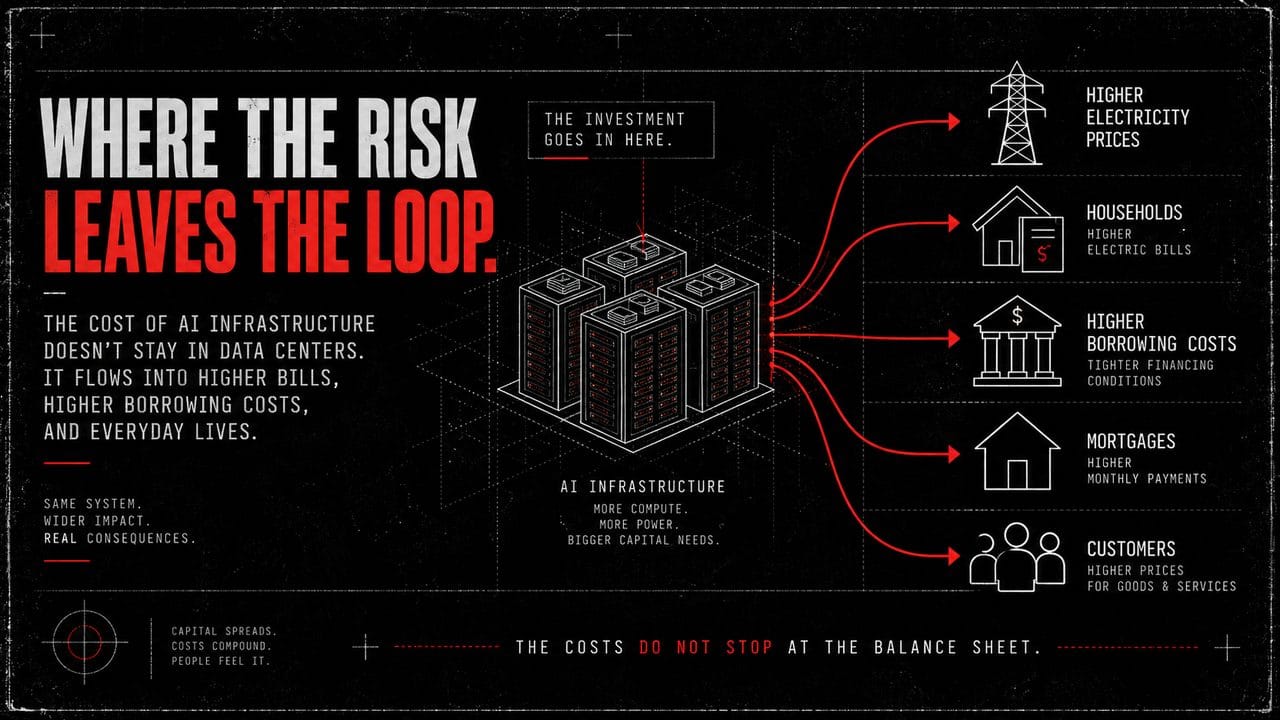
Inside the loop, the chipmaker invests in the lab, the lab buys cloud, the cloud buys chips. What I keep coming back to is the exits, where the cost reaches someone who never signed anything.
Your electricity bill
Bloomberg found that wholesale power prices at grid nodes near large data centers rose as much as 267% between April 2020 and April 2025. Wholesale is only part of a household bill, but residential rates in Washington, DC and Maryland are up 94% and 74% over five years. [26] Tariff reform, or contracts that make operators buy their own generation, could push those costs back where they started.
That reaches your contract too, not only your house. Once the hardware is paid for, power is usually the largest operating cost a data center has, and operators do not absorb it. Colocation leases commonly pass metered power straight through to the tenant. Cloud and hosting agreements carry escalation clauses tied to utility rates, or simply reprice when the term ends. A 267% move at a grid node in Maryland becomes a line item for the operator, then for the vendor renting racks from that operator, then for you at renewal. The bill takes a longer route to a business than to a household. It arrives at both.
Your borrowing cost
On September 16 the Federal Reserve raised rates for the first time since 2023, to a range of 3.75% to 4%. [27] Chair Kevin Warsh named three forces lifting long-term Treasury yields, with the 10-year near 5%. One of them: “The so-called hyperscalers are out in the market raising funding, so the competition for capital is real, and it partly explains the increase in yields.” [28] The Fed chair explicitly identified hyperscaler borrowing as one contributor to higher long-term yields. Bridgewater described the same risk in January: data center capex employs relatively few people, while the borrowing it requires can raise the cost of capital for sectors that employ many, like housing. [29]
Follow that back to the vendors. Debt like the GPU-backed facilities above gets refinanced as it matures, and each refinancing happens at whatever rate the market is charging that day. When rolling the paper costs more, a leveraged vendor can raise prices, thin out the service behind the agreement, sell to someone with a balance sheet, or stop. Three of those reach your contract. The fourth reaches it hardest.
Some of the money runs in loops. The electricity bill and the mortgage rate do not.
Some of the money runs in loops. The electricity bill and the mortgage rate do not.
The part that does not fit
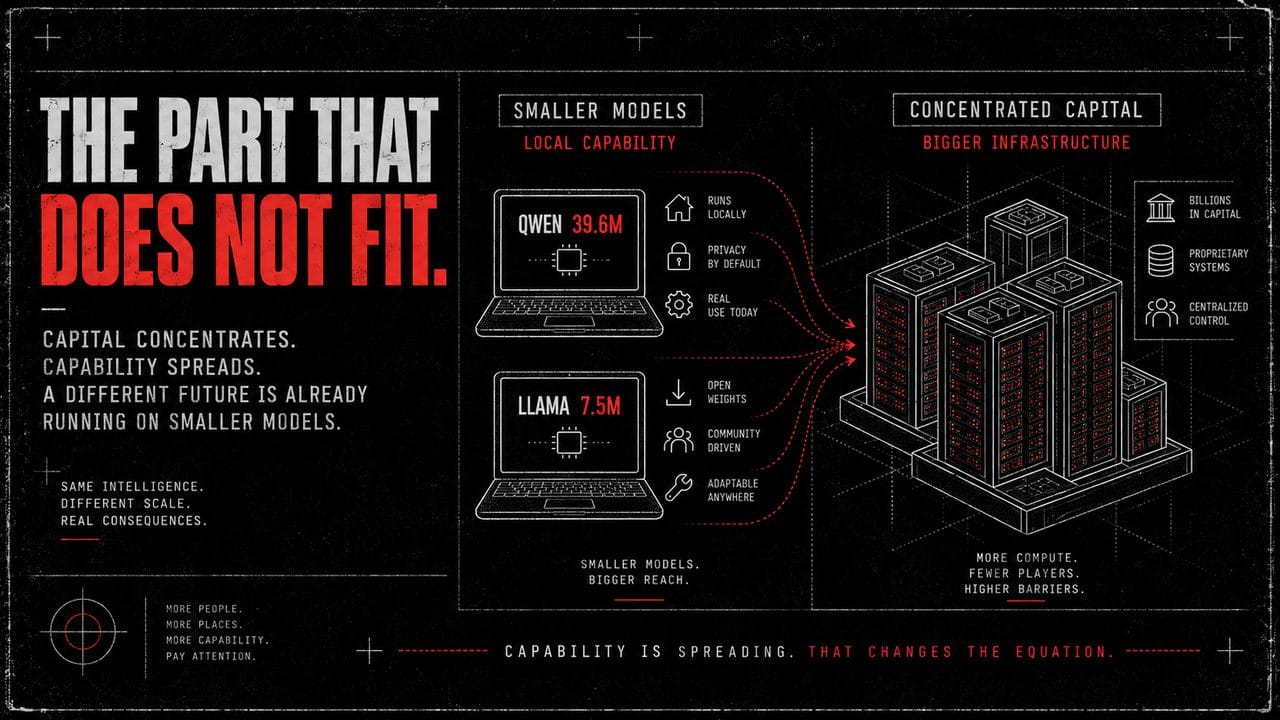
Hugging Face’s summer report counts 39.6 million monthly downloads of Qwen models in the format used for running them locally, more than five times Meta’s Llama. Models under one billion parameters account for 83% of all-time downloads. An 8-billion-parameter model on a laptop, once a milestone, is now the baseline. [30] Capital is concentrating into a handful of companies while usable capability is spreading to ordinary machines.
And two weeks ago Nvidia announced a deal to buy Hugging Face for almost $13 billion. [31] The company backstopping the resale value of its chips has agreed to buy the marketplace where the smallest models live.
I can see two readings, and they point in opposite directions.
The first is a hedge. If the largest data centers pay off more slowly than the loans expect, value shifts toward whoever owns the place small models are distributed from, and Nvidia would rather that be Nvidia. The bet on the biggest hardware comes with insurance on the smallest software.
The second is collateral protection. The company covering residual-value shortfalls on its chips now owns the hub where most open models are published. Every model it tunes to run well on older Nvidia silicon extends the useful life of the GPUs sitting behind those loans. A well-supported four-year-old chip resells. An orphaned one does not.
I lean toward the second, because it is the one Nvidia’s own guarantees pay it to make. Either way, one company now holds the hardware bet, the backstop on the hardware, and the software that decides how long the hardware stays useful. I would not trust my thesis without watching that.
What this means if you sign contracts
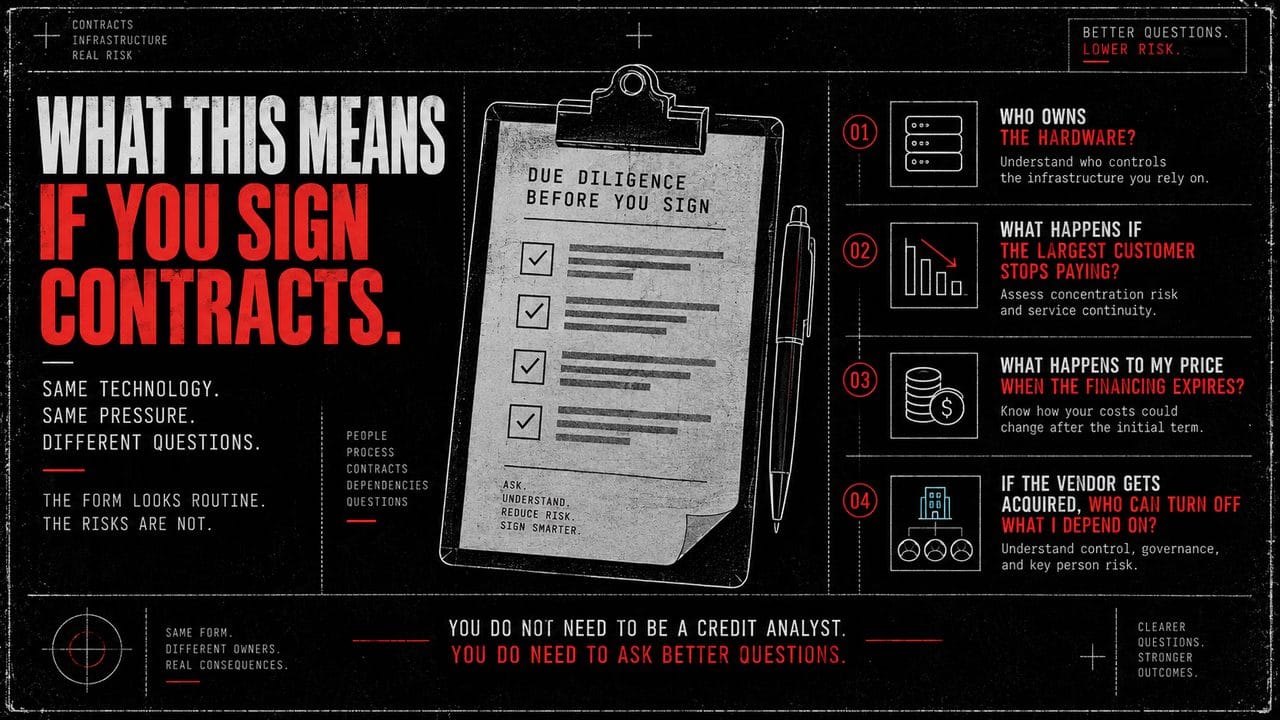
You do not need to become a credit analyst to buy AI. But if you are signing a three-year agreement with a company whose economics depend on these structures, you should understand what happens when one of them changes.
You do not need to become a credit analyst to buy AI. But you should understand what happens when one of these structures changes.
- Who owns the hardware my vendor runs on, and who holds the debt on it?
- What happens to my contract if my vendor’s largest customer stops paying?
- What happens to my price when the financing behind it expires, or the power bill behind it moves?
- If this vendor gets acquired, who can turn off what I depend on?
The point is not that these structures are inherently bad. It is that they create dependencies that do not show up in the product demo.
The debt can move. The obligation can change form. The risk still lands somewhere.
If you are buying AI, part of the job now is knowing where.
Related reading
- The AI Fear. What to be afraid of, and what to govern.
- AI’s Extraction Problem. Distillation, copyright, and the data moat.
- Seeing the Matrix. The value chain beneath the software seat.
Sources
- Jason Furman, X, Sept 27 2025; Fortune, Oct 7 2025. x.com; fortune.com
- Hatzius (Atlantic Council interview), reported by Tom’s Hardware and Gizmodo, Feb 2026. tomshardware.com; gizmodo.com
- Federal Reserve FEDS Note, Soto, Thieu, Allen, July 17 2026. federalreserve.gov
- Goldman Sachs Insights, 2026. goldmansachs.com
- Fortune, Apr 29 2026. fortune.com
- CNBC, Feb 12 2026. cnbc.com
- Vanguard, 2026. corporate.vanguard.com
- TechCrunch, Nov 2025 (Altman, $1.4T); CNBC, Feb 20 2026 ($600B). techcrunch.com; cnbc.com
- The Information, Q1 2026 (via Reuters/Yahoo). theinformation.com; finance.yahoo.com
- TechCrunch, Aug 17 2026. techcrunch.com
- Meta press release, Oct 2025 (ownership, lease term, residual-value guarantee); Bisnow (bond amount). investor.atmeta.com; bisnow.com
- CoreWeave press release, Mar 2026. investors.coreweave.com
- CoreWeave press release, May 2026. investors.coreweave.com
- RCR Wireless, Sept 16 2025, citing CoreWeave SEC filing. rcrwireless.com
- Bloomberg, Oct 7 2025. bloomberg.com
- Nvidia press release, Aug 10 2026. investor.nvidia.com
- TechCrunch, Aug 13 2026. techcrunch.com
- CNBC, Aug 10 2026. cnbc.com
- CNBC, Mar 9 2026; Bloomberg, Feb 2 2026. cnbc.com; bloomberg.com
- Fortune, Feb 2 2026. fortune.com
- Microsoft FY2026 10-K; The Register, Oct 29 2025; Om Malik, May 1 2026. sec.gov; theregister.com; om.co
- Quartz, June 16 2026 (Cursor deal); OpenAI, Aug 28 2026; CNBC, Aug 29 2026. qz.com; openai.com; cnbc.com
- Noah Smith, Noahpinion. noahpinion.blog
- CNBC, May 9 2026. cnbc.com
- Tomasz Tunguz (Lucent vendor financing figures). tomtunguz.com
- PolitiFact, June 12 2026, citing Bloomberg (Sept 2025) for the wholesale figure and its own analysis for residential rates. politifact.com
- CNBC, Sept 16 2026. cnbc.com
- Fortune, Sept 17 2026. fortune.com
- Bridgewater, Jan 2026. bridgewater.com
- Hugging Face, “State of Open Models: Summer 2026.” huggingface.co
- CNBC, Sept 3 2026. cnbc.com
