

A chart went viral this week. Maybe you saw it.
Each dot represents about 3.2 million people. 2,500 dots. 8 billion humans. The overwhelming majority of the grid is grey: never used AI. A band of green at the bottom for free chatbot users. A sliver of orange for people paying $20 a month. An almost invisible fleck of red for people using coding tools.
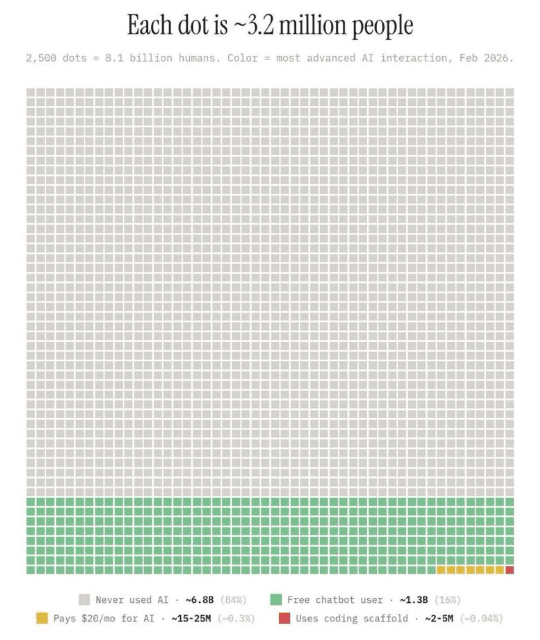
I haven’t seen a source for the chart. But the proportions are directionally consistent with what we know about AI adoption, and the image resonated for a reason. Nearly 3 million views in days. It made something felt into something visible.
Now read this: “Taste is a new core skill.”
That’s OpenAI president Greg Brockman, amplifying a prediction from Y Combinator cofounder Paul Graham that when anyone can make anything, the big differentiator is what you choose to make. 3.7 million impressions. Rick Rubin memes flooding the replies. Engineers nodding along.

Every person in that conversation plausibly lives in the orange and red dots. And they are shaping the cultural vocabulary around a technology whose impact will reach far beyond that sliver.
I want to be precise about what I mean. I’m not claiming a handful of tech leaders are writing AI policy. Formal governance is happening in regulatory bodies, standards organizations, and legislatures. What I’m pointing to is discursive governance: the power to define which skills matter, which roles survive, and what “good” looks like in an AI-native economy. That kind of framing doesn’t need regulatory authority. It just needs a platform and a receptive audience. And it tends to get absorbed downstream by hiring managers, corporate strategists, and educators without much examination of where it came from.
Yes, every technology starts with early adopters. Yes, early adopters naturally define initial best practices. And yes, the diffusion of AI is historically fast. 1.3 billion free chatbot users is not a marginal number. This isn’t an argument that adoption is slow or that early adopters are villains. This is an argument about what happens when the vocabulary early adopters create carries assumptions they haven’t examined.
“Taste” is not a neutral word
The idea that aesthetic judgment is universal and objective has a specific origin. Kant argued in the 18th century that taste was a shared human faculty, that aesthetic judgment makes a claim to shared validity rather than personal preference. His project was about the structure of judgment itself. The problem is what happened when that framework got absorbed into culture. Universality became a sorting tool. If your judgment doesn’t align with the standard, it’s not that you have different taste. It’s that yours is deficient.
Bourdieu spent his career showing how this works in practice. Taste functions as cultural capital. It sorts. It naturalizes hierarchy. The people with “good taste” aren’t perceiving something others can’t. They’re performing fluency in the dominant culture’s codes. And that performance gets rewarded with access, credibility, and authority while appearing to be nothing more than personal refinement.
Now, a fair counterpoint. In startup and product discourse, “taste” usually doesn’t mean aesthetics. It means problem selection, quality bar, product judgment, constraint definition. It’s a cognitive filter developed through iteration and feedback, not inherited class signaling.
I take that seriously. But it raises its own question: if what we actually mean is judgment, why are we reaching for a word with 300 years of philosophical baggage? “Judgment” is concrete. “Taste” carries an aura of innate refinement that judgment doesn’t. That aura isn’t accidental. It does work. It suggests the capacity is natural rather than learned, individual rather than structural, and available to anyone with the right sensibility. Naming it “taste” makes it easier to not notice when privilege is operating.
- A narrow cohort relative to the workforce being reshaped is defining the essential competency for an era that will alter how millions of people work and earn.
- The competency they’ve named overlaps significantly with existing privilege: accumulated cultural exposure, aesthetic confidence, pattern recognition built through access to the best tools, education, and networks over years or decades. That’s not a conspiracy. It’s a pattern worth examining.
- The incentive structure reinforces it. AI labs monetize enterprise buyers, developers, founders, and knowledge workers. The “core skills” language is built for and marketed to that cohort. The grey dots on the chart aren’t just outside the conversation. They are economically irrelevant to the companies shaping it.
There’s a reasonable objection here: AI tools lower barriers to iteration. More people can develop judgment faster than before. Maybe the drawbridge is actually shortening.
But access to iteration is necessary, not sufficient. Iteration develops judgment when you have the context to evaluate the output. A person who has never seen effective product strategy can generate fifty product strategies with AI and still not know which one works.
The tool compresses production. It does not compress the accumulated context that makes evaluation possible.
And “taste” as a framework obscures that distinction by suggesting the evaluative capacity is self-evident rather than built through specific kinds of exposure that remain unevenly distributed.
Taste materializing
Here’s where it becomes material. Execution is being commoditized. Millions of people built careers, identities, and economic stability on the ability to execute well. Design production. Code implementation. Content creation. Analytical reporting. AI is compressing those roles faster than most organizations are willing to say out loud.
Telling those people the answer is “develop taste” is telling them to acquire the one thing that has historically been most difficult to acquire without already having it.
This connects to what I wrote in Part 1 about performative truth. “Taste” is performing the role of discursive governance in the AI conversation. It offers a sense of order, a framework for who thrives and who doesn’t, a way of sorting the future. But it does this without any of the accountability, transparency, or structural examination that actual governance requires.
The question isn’t whether judgment matters in an age of abundant generation. It does. The question is who gets to define what good judgment looks like, who is excluded by that definition, and whether we’re honest enough to examine the possibility that the answer tracks closely with who already had power before AI entered the conversation.
Language shapes hiring. Hiring shapes economic outcomes. Early power users shape language. Language carries implicit assumptions. Those assumptions can encode advantage. That’s the chain worth watching.
Part 2 of a series on the critical theory challenges AI is surfacing. Part 1 introduced performative truth. Next: what happens when meaning itself is produced without any connection to reality.
