

WP Tools
See how I lead product, AI, and transformation.
WordPress Operations CLI
2025 to now
I built the command line that runs my WordPress sites.
wpt turns every repeatable WordPress task, publishing, fixing, auditing, optimizing images, into one governed command. I run six sites from the terminal instead of clicking through six dashboards, and every change is validated before it ships.
- sites, one CLI
17 → 1
- scripts into one pipeline
17
- checks before each deploy
8 steps
- pull, validate, deploy, verify
The Problem
Six WordPress sites, and the admin screen does not scale. Every routine change, schema, Yoast, images, a content edit, means clicking through a dashboard, one site at a time.
The fast workaround is worse. A one-off script for each task, piling up, drifting out of sync, breaking quietly the next time the content changes.
The Constraint
One Bad Edit Ships
Hand-editing Gutenberg block markup breaks layout and schema in ways you do not see until the page is already live.
So speed alone was not the goal. Every change needed a gate: validate the markup, check the schema, then deploy, the same way every time, on every site.
How a change reaches the site
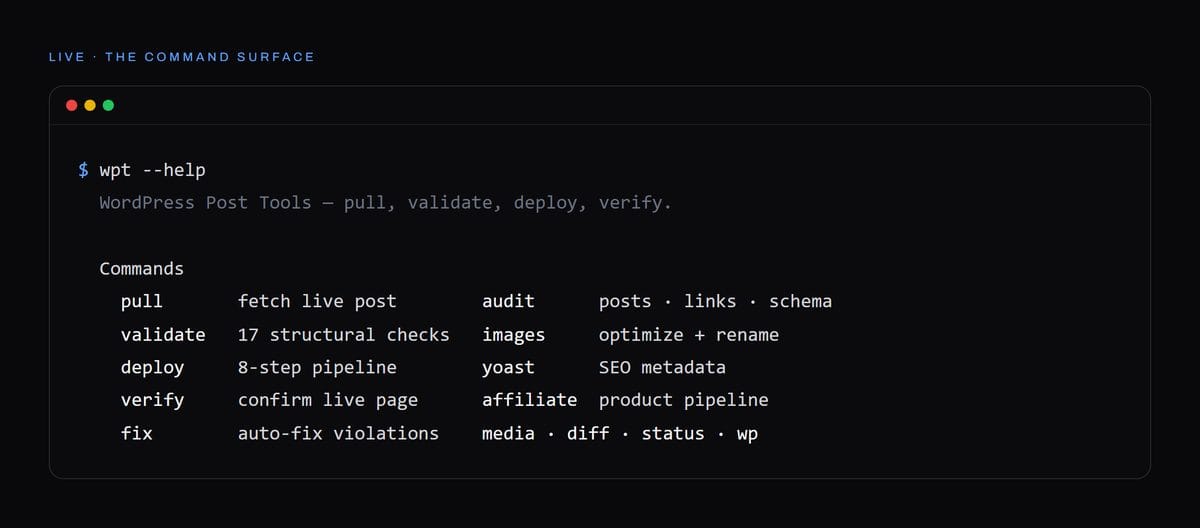
Pull, validate, deploy, verify. The same path every time.
01
Pull
Fetch the live post into a local file, with its sync state tracked.
- Posts & pages
- Yoast & schema
- Media
02
Validate
Seventeen structural and Gutenberg checks. Auto-fix the violations it can, block the ones it cannot.
03
Deploy
An eight-step pipeline pushes the change, gated so prose edits run through the humanizer first.
04
Verify
Fetch the live URL, confirm the change rendered, and purge the cache.
How I build it
wpt has one rule: if a task is worth doing twice, it becomes a verb, not a script. The affiliate pipeline is the proof. Seventeen one-off scripts from a single campaign, map, image, inject, verify, collapsed into one governed verb chain that runs on any site. A throwaway script would have rotted by the next campaign. The verb still runs.
RevMax and the Gemini Analytics Companion are built the same way.
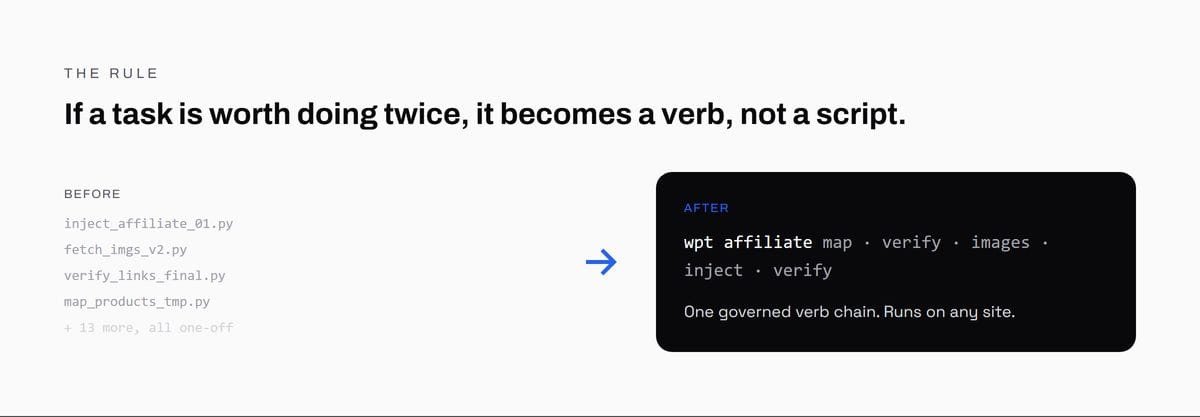
One pipeline replaced seventeen scripts.
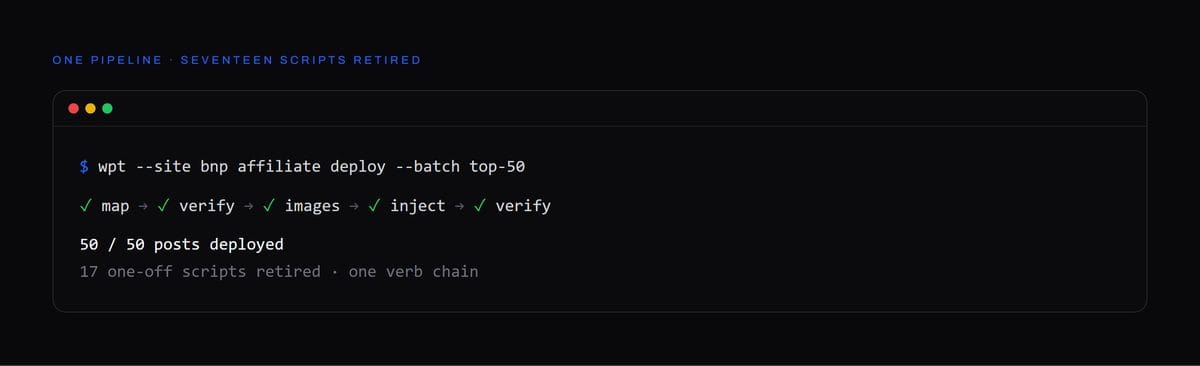
After a fifty-post affiliate campaign on one site, I had seventeen one-off scripts to inject products, fetch images, and verify links. They worked once, and they would not survive the next campaign. So I folded the whole sequence into wpt: map, verify, image, inject, verify, one governed chain, deployed across the top fifty posts.
Now it runs on any site from one command. No hand-editing, no throwaway code, the same validated path every time.
One pipeline, six sites, every deploy validated.
A command line that runs six WordPress sites, with every change validated before it ships.
Multi-Site
6 sites
Run from one CLI
Consolidated
17 → 1
One-off scripts into one pipeline
Gated
17 checks
Run before every deploy