

The American Academy of Pediatrics
See how I lead product, AI, and transformation.
VP of Strategy & UX (Adage)
Digital Transformation Lead
2016 – 2023
The Academy asked for a digital strategy. I led the seven-year transformation it actually needed.
AAP hired Adage to write a digital strategy. In discovery, I made a different call: the problem was not the website. The problem was that a 67,000-member institution had no shared way to decide what its digital enterprise should do next. I reframed the brief into a board-sponsored Digital Transformation Initiative, built the governance to run it, and led it as the outside partner AAP trusted for the next seven years.
- Ecommerce Revenue
+40%
- Order Value
120+
- Brands Unified
7 Years
- Transformation Led
At a glance
67,000+ members, 120+ websites and brands, 30+ membership paths
- 10 districts, 66 chapters, 52 sections, 460 employees
- Seven-year engagement with sustained executive sponsorship and annual renewal
- 15 agency and 40+ client collaborators at peak
- shopAAP: +30% revenue and +692% mobile sessions, year over year
- Recommendation-driven personalization: about +40% average order value
- Federated search unifying 16 content sources
The Brief, and the Real Problem
The ask was a digital strategy. What discovery surfaced was structural.
AAP had grown, over a generation, into one of the most respected institutions in American medicine and one of the most fragmented digital estates I had seen: more than 120 websites and brands, legacy platforms, and member, clinician, public, publishing, education, advocacy, and commerce experiences that had each been built on their own terms. The seams showed where they mattered most. Members could not find what they needed quickly, and clinicians told us plainly that at the point of care they reached for Google or Wikipedia because the Academy’s own site was slower. One member named the stakes directly: when people go to the site and cannot find policy, the risk is damage to the AAP name itself.
Three conditions defined the starting point. The digital estate was fragmented. Findability had eroded to the point of losing trust. And a single, undifferentiated experience served general pediatricians, subspecialists, residents, and early-career physicians who each needed something different.
Why It Was Hard
Building features was never the hard part. The hard part was that nothing in the organization could decide, across the whole enterprise, what to build first.
You cannot disrupt a platform people depend on while building its next generation.
A 500-person institution spread across 10 districts, 66 chapters, and 52 sections generates digital demand from every direction. IT received constant requests, each legitimate to the group raising it, none ranked against a shared definition of member value. With 120+ brands and no common prioritization model, every group optimized for itself. That is normal in an institution this large and distributed. It is also why another redesign would have changed very little. Without a mechanism to set priorities across departments, the next redesign would have fragmented again.
The Bet
I did not sell a website. I convinced leadership to fund a transformation.
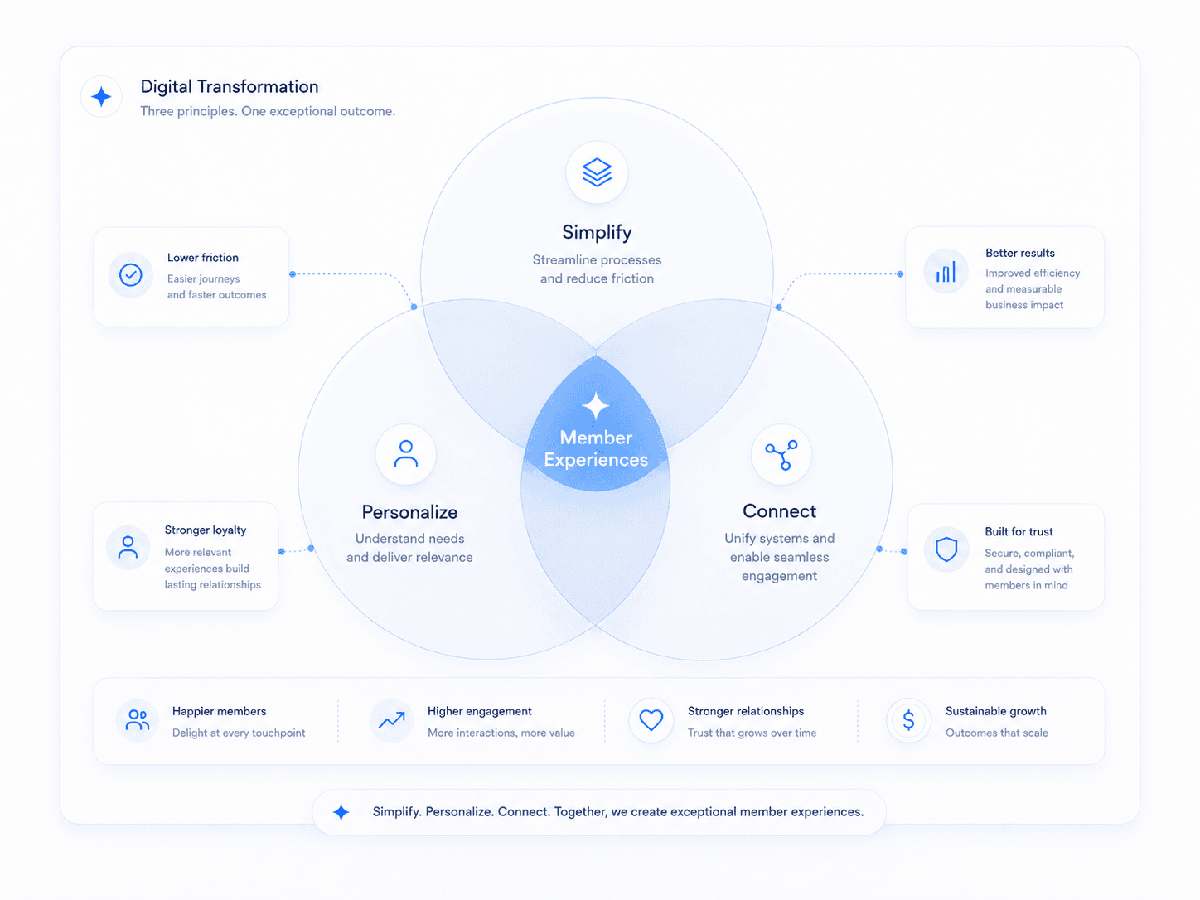
Working with the executive sponsor who later became CEO and with the CTO, I redefined the engagement against two board strategic goals: enriching member value and engagement, and improving how the Academy communicates with members, stakeholders, and the public. That reframing changed the trajectory of the work. It gave the effort executive sponsorship, board visibility, and sustained investment. It also gave the organization a single test for deciding what mattered: does this simplify, personalize, or connect the member experience?
That principle set, Simplify, Personalize, Connect, still anchors the initiative years later.
The System I Built
The most durable thing I built was not a product. It was the way AAP decides.
I established a governance model with two bodies. A group of Governors set direction and ranked work. A Core Team of members reviewed releases against real member needs. Together, they re-prioritized the IT backlog against the core principles so that requests from any one group were weighed against member value rather than volume or politics.
AAP was my third and largest agile transformation. I coached the product and engineering teams in agile methods, restructuring the group into scrum teams. I also trained the internal teams to run their own analytics, so improvement did not depend on the agency.
The point was to make transformation run as a system rather than as a queue of projects, and to keep running after any single release and after any single partner.
01
Vision & Core Principles
Simplify, Personalize, and Connect. Our mantra and organizing idea.
02
Governance
I established a governance model with two bodies. A group of Governors set direction and ranked work. A Core Team of members reviewed releases against real member needs.
03
Data & Analytics
I also trained the internal teams to run their own analytics, so improvement did not depend on the agency.
The Result
What AAP bought was not a website. It was a transformation with a spine that held.
Seven years in, the initiative still runs on the strategy, principles, and governance I put in place, and it still produces commercial results alongside the institutional ones. I turned a strategy brief into a transformation model, aligned leadership around it, and built the system that made the change stick.
That principle set, Simplify, Personalize, Connect, still anchors the initiative years later.
Sixty-six Thousand Members, Dedicated to the Health of All Children.
Deliverables
- Strategy
- Vision
- Roadmap
- Brand Strategy
- Brand Architecture
- Design System
- Pattern Library
- Digital Experience Platform
- Personalization Strategy
- Content Strategy
- Data/Analytics Strategy
- Change Management
- Agile Transformation
Approach
- Initial Discovery
- Visioning
- Quick Wins
- Communication Plan
- Design Thinking Workshops
- User Research
- Stakeholder Interviews
- Digital Universe Mapping
- Entity Mapping
- User Journey Discovery
- Technical Discovery
- Feedback Loop Establishment
Stakeholders
- CEO
- SVP Marketing, Sales, Membership, Customer Care
- SVP Information Technology
- SVP Publications
- SVP Operations
Year
2016 – 2023
The Proof: From 17 Clicks to an Amazon-Like Store


The clearest proof of the strategy was commerce, and the mandate for it came from the CTO. It took 17 clicks to complete a purchase on AAP’s store. He put the goal simply: he wanted members to have an Amazon-like experience.
The team I led consolidated AAP’s scattered bookstore into one responsive shopAAP experience, reduced the path to purchase, and introduced cross-sell and a machine-learning recommendation engine that personalized what each member saw. Year over year, the redesign delivered a 30% revenue increase and a 692% increase in mobile sessions, on a 455% rise in page views.
Personalization carried its own weight. Orders that included a recommendation produced about 40% higher average order value, $374 against $268, and recommendations drove more than $538,000 in revenue. Over the fourteen-month window we measured, the store processed roughly $35.6 million across 131,000 orders.
Search told the same story from the other side. The Academy’s legacy search could return an empty page. The team rebuilt it as a federated search that ranked results with machine learning, unifying 16 separate content sources into one faceted system and making it far more likely that a member looking for policy would find it on AAP.org instead of on Google.
Both of those bets, the recommendation engine and the search ranking, were machine learning put to work years before AI became the headline. I judged them the way I judge AI now: by revenue and findability, not novelty.
We collapsed 30+ membership paths into a single application and automated an approval process that had been manual. That cut staff effort and made joining easier. Alongside it, we moved AAP.org off legacy SharePoint, shipped a reusable design system and pattern library, and rebuilt the member journeys that carried the most weight: the account and profile experience, the member directory, and the continuing-education transcript tools clinicians rely on to claim CME. The designers who ran that search, commerce, and membership work were people I hired early in their careers and grew into leads and directors. The standard held long after any single project shipped.
Member Understanding
- User Research
- Stakeholder Interviews
- Board of Directors Interviews
- Member Interviews
- Staff Interviews
User Journeys
- Perona Development
- Macro User Journey
- Mico User Journey
- Data Review
- Click-stream Data Analysis
Vision
- Core Drivers
- Story Boarding
- Vision Workshop
- Prioritization Workshop
- Digital Capabilities Review
Strategy
- Multi-Year Roadmap
- 90 Day Quick Wins
- Organizing Ideas
- Board of Directors Presentation
- Team Structuring
The Approach
When I first engaged the American Academy of Pediatrics, they asked for a digital strategy. As conversations deepened, it became clear that the true need of the organization was wider and deeper than a digital strategy.
Connected to the Academy’s five-year goals and objectives, Goal 4: Enhance the Academy’s communication with members and stakeholders. With guiding objectives to transform the Academy into a digital organization that leverages user-focused and user-friendly digital products in response to member needs.
I began the engagement with a six-month research and discovery sequence. The foundational vision and organizing idea, along with the core drivers to “simplify, personalize, and connect,” has endured as a mantra for the digital transformation initiative.
I led a cross-functional agile team in all aspects of the digital transformation from user research, usability studies, discovery and strategy workshops, agile transformation consulting, product management, branding, user experience design, user interface design, user journey development, digital strategy, business strategy, operational process improvement, and change management. My role as the digital transformation executive included on-going consulting with AAP’s leadership team over more than seven years of digital transformation.
At its largest the engagement team included 15 agency team members, and more than 40 client team members directly collaborating on API integrations, business rule implementation, usability testing, and product management. Many others contributed in the discovery process. I was responsible for team leadership, cross-team collaboration, stakeholder management, user experience direction, and change management.
Together with the team, the work included a complete redesign of AAP.org, a federated search implementations tying together more than 15 web sites and platforms, simplified user experiences for membership (which includes over 30 membership types/paths), education platform integration across platforms and APIs, search engine optimization, and much much more. The depth of breadth of the AAP’s digital platforms includes ecommerce, memberships, subscriptions, journals, publications, advocacy, policy, and more.
Selected Milestones
2016 - 90 Days
Delivered series of quick-wins including revamped home page experience based on data and user behavior
2016 - 2017
Enterprise federated search application (single page application) launched bringing content from 16 separate content sources into a singular search experience
2016 - 2017
Continuing education credit tracking application for CME and CMU launched
2017 - 2018
Membership self-service portals launched
2019 - 2020
AAP.org Redesigned and Launched
2020 - 2021
AAP Learning Management System (LMS) Selected and Implemented
2021 - 2022
ShopAAP.org migration to Optimizely v12 on .NET Core, and 12 Membership Sign-up Flows Launched
The transformation held because it reached across the enterprise and built the people to sustain it.
Federated Search
16+
Sources Unified
Membership
30+
Paths Unified
Team
4
Leaders Developed