

RevMax
See how I lead product, AI, and transformation.
AI Revenue Intelligence
2025 to now
I built an AI system I trust to decide where revenue goes.
RevMax pulls a publisher's revenue and traffic data, from GA4, Search Console, AdSense, Amazon, and Bing, into one model, then ranks what to do next by the money on the table. I designed it, I build it, and I govern its AI the way I would govern a team.
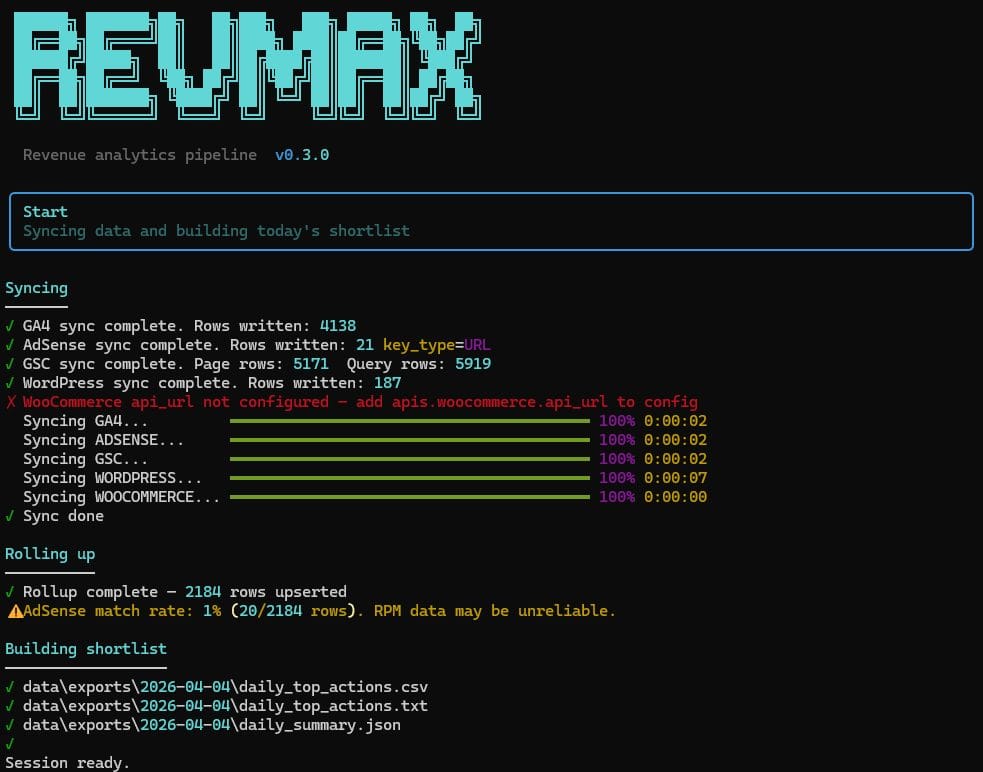
- data sources, one model
100s
- of pages ranked per run
~$4,700
- a year behind the top play
3 roles
- govern every change
The Problem
A publisher’s revenue signal lives in five places at once. The one question that pays, which page do I optimize first and what is it worth, has no clean answer.
The obvious fix is to point an AI at it. That’s the trap. A single agent answers fast and sounds certain, and revenue decisions can’t run on a confident guess.
The Constraint
No Team To Catch It
I build RevMax alone, and its output decides where my own money and hours go. There’s no team standing between a wrong number and a real spend.
So a person reviewing the AI wasn’t enough. The discipline had to live in the system: govern the AI like a team, and nothing ships until it has been reviewed and challenged in writing.
How it turns data into a decision
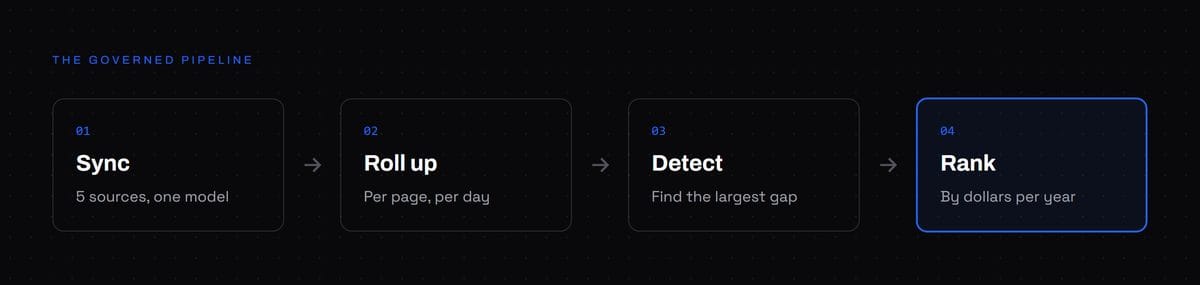
Five sources in, one ranked decision out.
01
Sync
Revenue and traffic from five sources, pulled into one local model.
- GA4 & Search Console
- AdSense & Amazon
- Bing
02
Roll up
Cross-source metrics, recomputed per page, per day, so traffic and earnings line up on the same row.
03
Detect
Detection finds where the gap between traffic and earnings is largest, the pages leaving money on the table.
04
Rank
The backlog comes out ordered by projected dollars per year, each opportunity with the play to run and the effort it takes attached.
How I build it
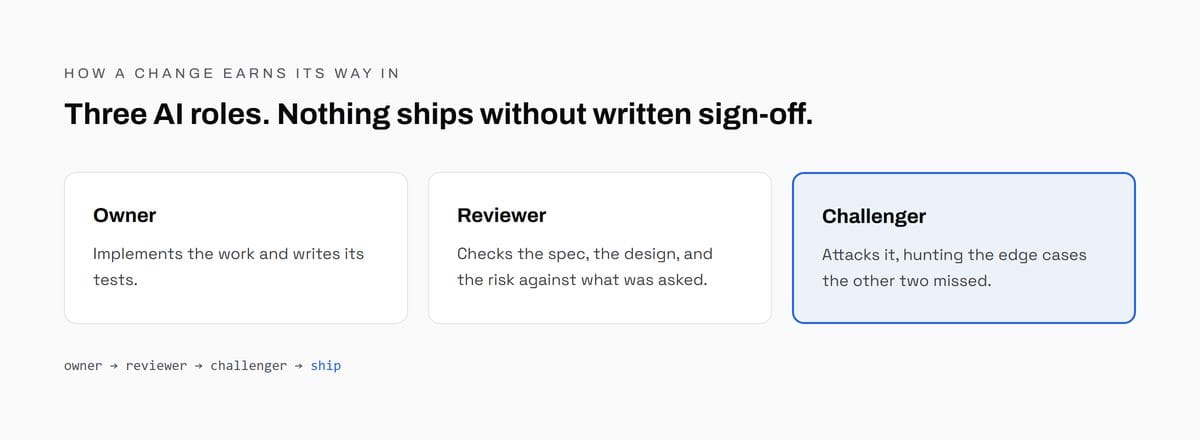
A governed pipeline of AI agents, not a single chatbot. Every change runs through an Owner who builds it, a Reviewer who checks it, and a Challenger who attacks it. On the feature that scores AEO opportunities, that paid off: the Challenger forced cost guardrails, a dry-run mode, and per-day caching before it could ship and quietly burn through paid API calls. A single confident agent would have shipped the version that cost me money.
wpt and the Gemini Analytics Companion are built the same way.
One real run decides the work for me.
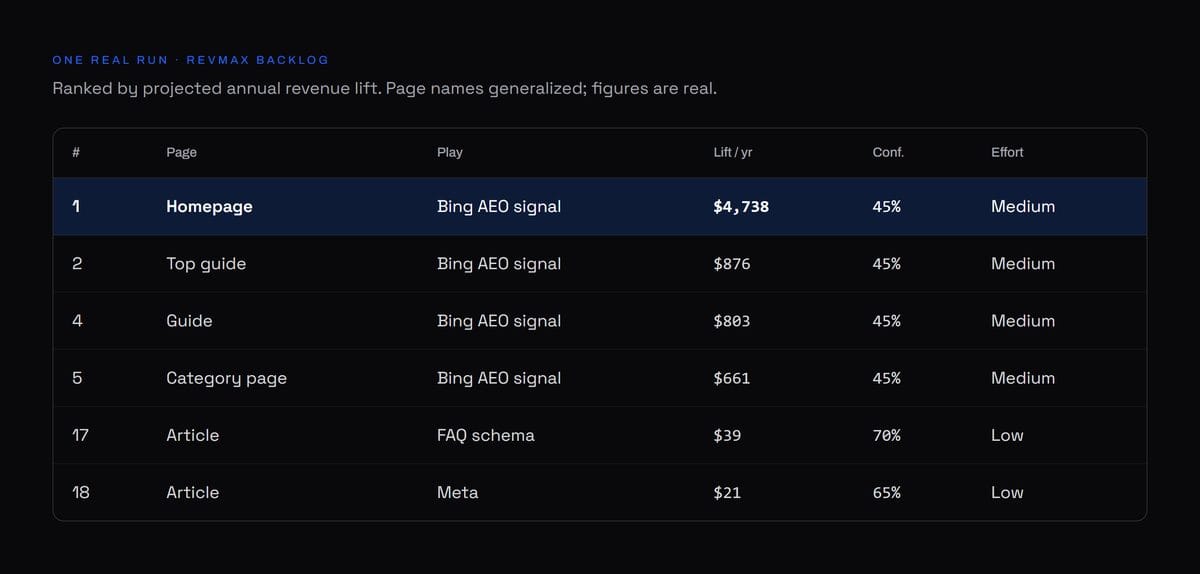
A real question from a content site I run: across hundreds of pages, which ones earn optimization first, and how much revenue is on the table? RevMax syncs the five sources, recomputes the rollups, and runs detection. The backlog comes back ranked. At the top sits a single page with about $4,738 a year behind one optimization, then the next, then the next, each with the play and the effort attached.
I don’t decide where to start by feel. The system decides it for me, ranked by what is worth doing first, and I work down the list.
One run proves the bet: governed AI, on real money, making the call.
A governed AI system that runs today, on real data, deciding where real revenue goes.
Top Opportunity
$4,738
A year, behind a single page
Live Momentum
+22%
GSC impressions, vs prior 28 days
Trailing 8 Months
1.3M
GSC impressions analyzed