

Affiliate Autopilot
See how I lead product, AI, and transformation.
Affiliate Monetization Infrastructure
2026 to now
A new operating model for affiliate publishing
Affiliate tools manage links publishers have already placed. They track clicks, repair URLs, and improve how products appear. They do not show where a relevant commercial opportunity is missing across the archive.
- Product strategy, research, UX, architecture, development, production validation, and go-to-market strategy
Product
- A WordPress platform for governing affiliate products and placements across large content libraries
Market
- Established publishers whose archives have outgrown manual affiliate operations
Status
- In production, governing a full product catalog across an evergreen archive
The Market Gap
The category begins too late.
Link managers organize URLs. Product-card plugins improve presentation. Analytics measure clicks. Each assumes the publisher has already found the opportunity, selected the product, and placed it in the right article.
That leaves the harder operating questions unanswered. Which articles should carry an offer but do not? Where should a product appear across a large archive? What will a placement change affect before it goes live? Which pages are intentionally noncommercial, and which have simply been missed?
I reframed the problem from managing affiliate links to managing commercial coverage across a publication. The article should not own the product.
The product was not the card rendered on the page. It was the system governing when, where, and why that card appeared.
Controlled Automation
Automate Execution, Keep Judgment Visible
Revenue automation creates a clear tension. More autonomy increases efficiency, but reduces trust when the system cannot explain itself. I chose predictable, publisher-controlled automation.
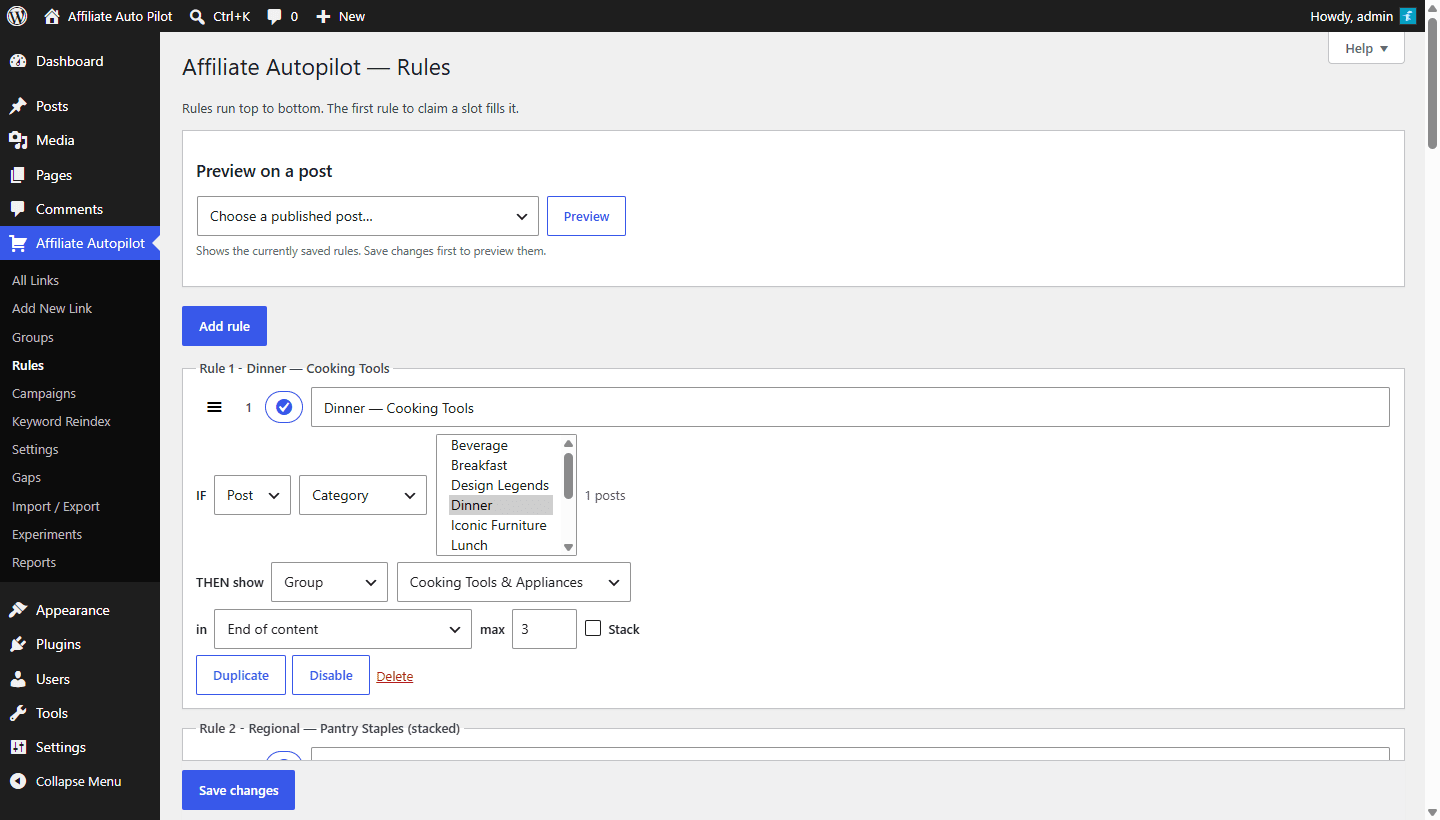
Editorial choices take precedence. Placement policies show their expected reach before publication. Products can be pinned, excluded, suppressed, or given article-specific copy. Campaigns carry their own expiration. The same inputs produce the same result.
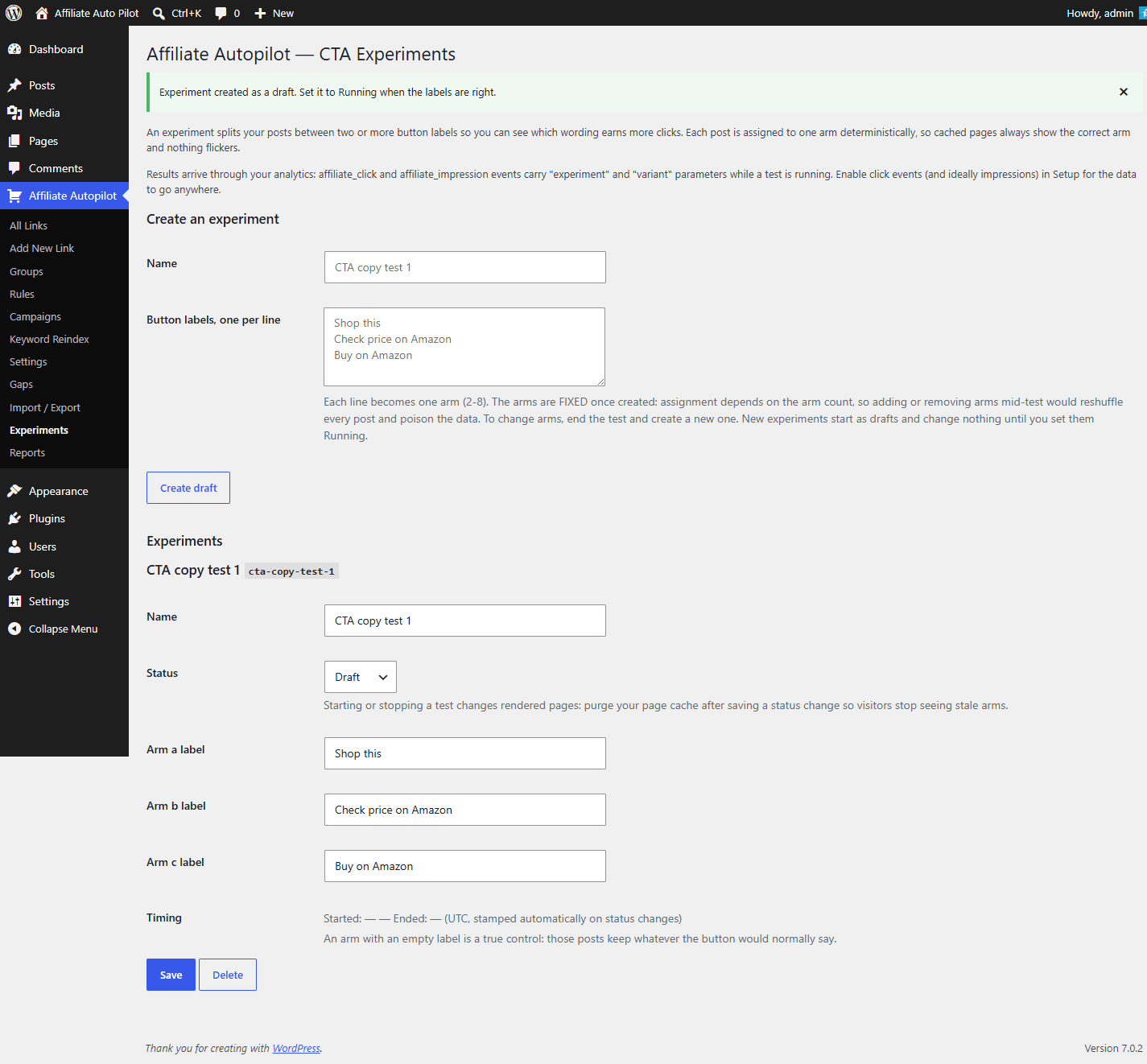
That principle also shaped the experimentation model. Large WordPress publishers rely heavily on page caching, and visitor-level randomization can fragment the cache or alter the experience after load. Affiliate Autopilot assigns each article to a treatment using a fixed function of the article itself, resolved before the page renders. A full-page cache always serves the correct arm, with no flicker and no second request to correct it.
Automate repeatable execution. Keep commercial judgment visible and reversible.
The product system
Affiliate Autopilot connects four operating layers.
01
Product inventory
Each product lives as a reusable record. Updating it changes every rendered placement that uses it.
- Destination, network, identifier
- Image, description, CTA
- Publisher-defined terminology
02
Placement policy
Products appear through editorial pins, keyword matching, broader rules, time-bound campaigns, or manual inline placement. The system applies these sources in a defined order, so a deliberate editorial decision always overrides broader automation.
03
Coverage intelligence
The plugin evaluates the archive using the same logic that produces live placements, running from a precomputed snapshot so a warm page request adds no database queries. It identifies thin coverage, unused inventory, available matches, exclusions, and intentional suppression.
04
Measurement
Clicks and impressions carry the same product, article, placement, CTA, and experiment identifiers the operating system uses. Placement and performance are one model rather than disconnected tools.
What production changed
Real content and a real catalog exposed assumptions that feature design alone would not have found.
Copy written for one article often became inaccurate when reused elsewhere. Product truth now lives separately from article context: the default describes the product, and article-specific framing belongs to the placement. That was not a writing problem. It was a content-model problem created by reuse.
Generated keyword variants were unusable in more than nine cases out of ten, while a single term drawn from the publisher’s own vocabulary connected one product across dozens of relevant articles. So the product automates the application of domain knowledge instead of trying to generate that knowledge through string variation.
Some pages should carry nothing at all. Intentional suppression is recorded as an editorial decision rather than reported forever as a failure.
RevMax and wpt came out of the same sequence: find the work that repeats, decide what software is allowed to own, prove it live.
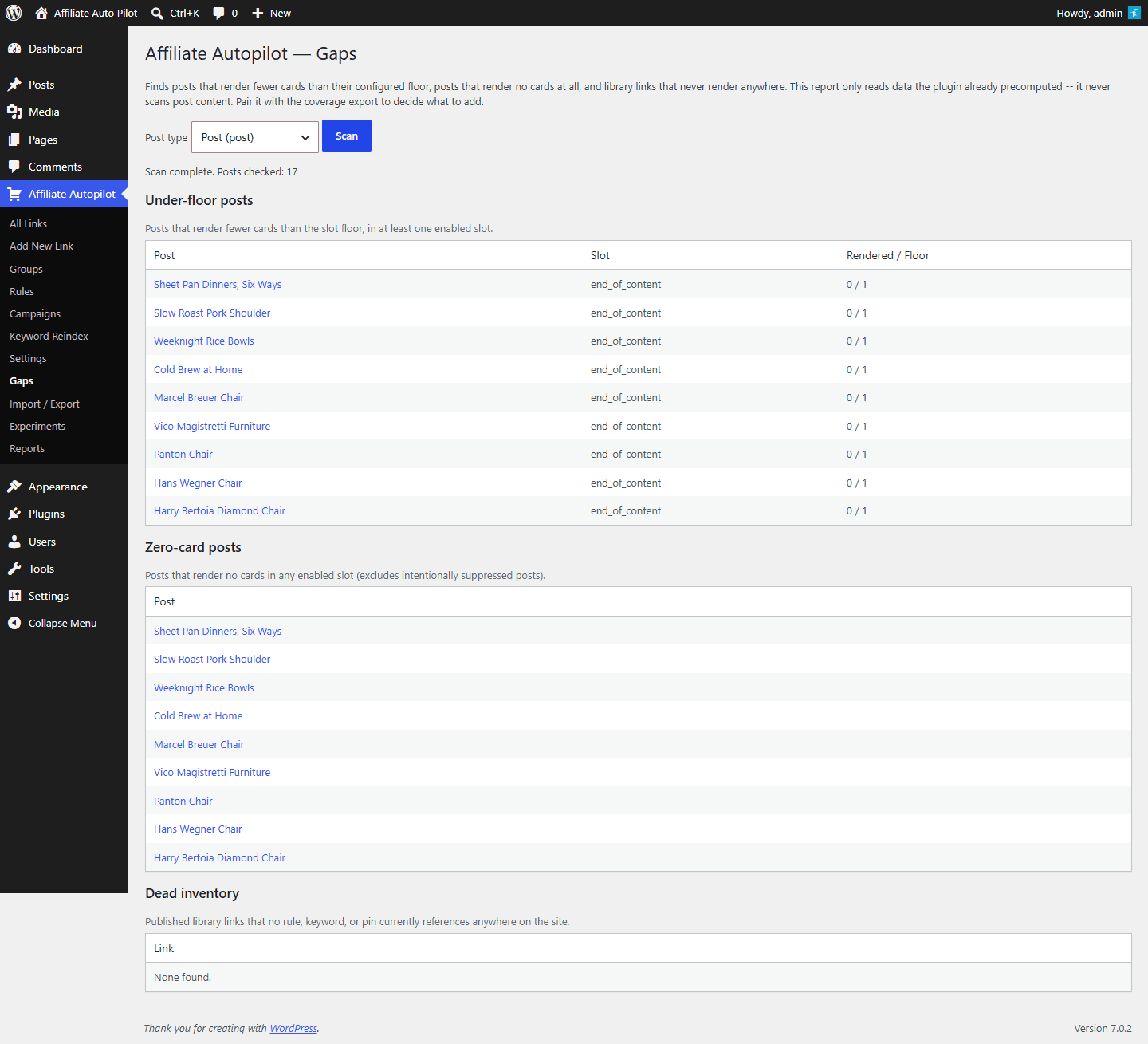
Analytics cannot show you a missed opportunity.
Take an article that appears to be performing well. It has traffic, it carries affiliate products, and it produces clicks. It is also missing the product most directly connected to its subject.
Nothing in the analytics looked broken, because analytics can only measure what exists. They cannot report the relationship a publisher failed to create.
Affiliate Autopilot applies the live placement model across the content library and identifies where the product catalog and the archive fail to meet. That turns monetization into a queue of specific decisions: add a missing product, improve a product’s matching terms, pin a deliberate recommendation, exclude an irrelevant one, or leave the page intentionally unmonetized.
The objective is relevant commercial coverage, measured by how much of the archive carries something a reader would actually want.
Product screens, shown on a demo library.
Affiliate Autopilot is in production: an entire product catalog under central control, an archive moved off hand-maintained placements, and no article opened to change any of it since.
Copy Governance
Nearly half
of default product copy needed revision once reused elsewhere
Mechanical Variants
9 in 10
generated keyword variants produced no usable coverage
Domain Vocabulary
Dozens
of articles opened by a single term in the publisher’s own vocabulary